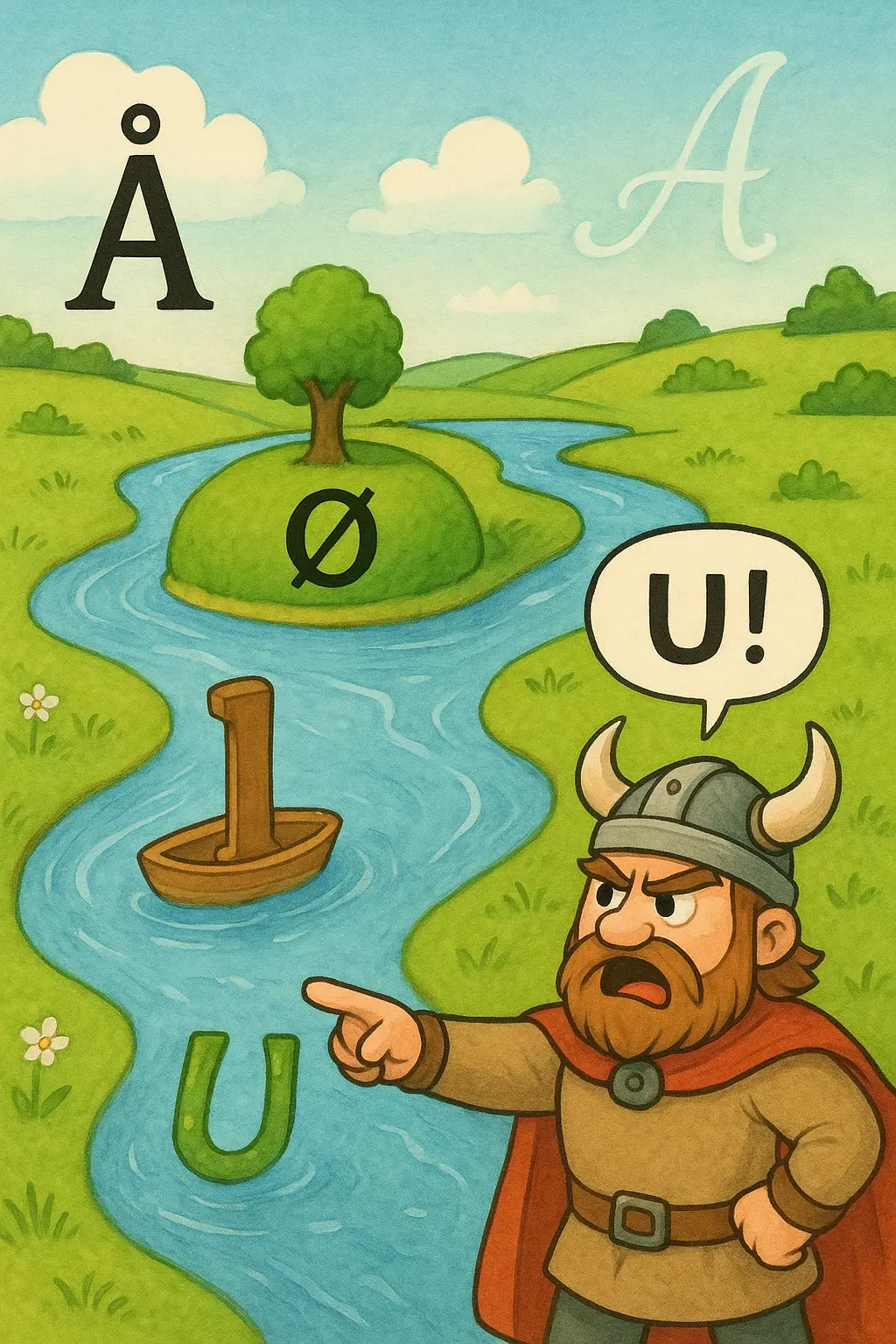
Can you learn Danish words that are only one letter long? Danish has a few, and they are surprisingly useful. While they look simple, remembering the difference between å and ø, and how they sound, can be tricky for beginners.
The One-Letter Danish Words
Standard Danish has three one-letter words you will meet every week. Two more are common in Jutlandic dialects, so you may hear them if you live or work in Jutland.
| Word (Danish) | Meaning (English) | Memory Trick |
|---|---|---|
| å | A stream / small river (en å) | The ring on top looks like a bubble floating on a stream. |
| ø | An island (en ø) | The line through the O looks like a strip of land in the water. |
| i | In | Same as the 'i' in "inside": i Danmark (in Denmark). |
| I | You (plural) | Capital I talks to a group: Kommer I i morgen? (Are you all coming tomorrow?) |
| a | I (dialect) | In many Jutlandic dialects a replaces jeg (I). |
| æ | The (West Jutlandic dialect) | Placed before the noun, so æ hus means huset (the house). |
The Memory Story Method
Imagine you and your friends are standing i (in) a small å (stream) on a tiny ø (island). Someone shouts: “Kommer I?” (Are you all coming?). One picture now holds four words, and the funny scene makes it easier to remember than a list.
How to pronounce them
- å sounds roughly like the vowel in British English “law”, but shorter.
- ø is close to the vowel in French “peu” or German “schön”. Round your lips as if saying “oo”, then say “ay”.
- i sounds like the “ee” in “see”.
These are only approximations. Listen to a native speaker and repeat the whole phrase, such as en lille ø (a small island), rather than the letter on its own.
How to use the words in real sentences
The memory story is useful only when it leads to correct sentences. Jeg bor i Danmark means “I live in Denmark,” so i is the small word that introduces the place. Vi går over en å means “we walk across a stream,” while Bornholm er en ø means “Bornholm is an island.” Read each sentence slowly, then replace the place or noun with something familiar from your own life. Personal examples are easier to retrieve than a list learned without context.
Be careful with capital letters and pronunciation. Danish nouns are not normally capitalized, so å and ø are usually written in lowercase inside a sentence. The letters å and ø also have sounds that do not match English spelling. Listen to a native example and repeat the whole phrase; focusing on the isolated letter can make the sound feel more mysterious than it is.
A three-step recall drill
- Cover the English column and say what each Danish word means.
- Cover the Danish column and write the word from the meaning and memory image.
- Use at least three words in your own sentence, then check the preposition and noun article.
Try this short challenge: complete Jeg bor ___ Danmark, Vi ser ___ when you mean an island, and De går over ___ when you mean a stream. The expected answers are i, en ø, and en å. Repeat the exercise tomorrow without looking at the table. Spaced recall is more useful than rereading the same explanation many times in one sitting.
💡 Practice Tip
Want to see these words in action? Use ourInteractive Practice Hub to test your knowledge of basic Danish nouns and prepositions!
Why Use Visual Learning for Danish?
A vivid picture gives your memory a second way to find a word. When the spelling of ø and å feels unfamiliar, linking each letter to a physical object (an island or a stream) gives you a hook to hang the meaning on. Combine the picture with regular recall practice, like the drill above, and the words will stick.
For more visual Danish lessons, visit our YouTube channel:
📺 Watch LearnDanishLab on YouTube