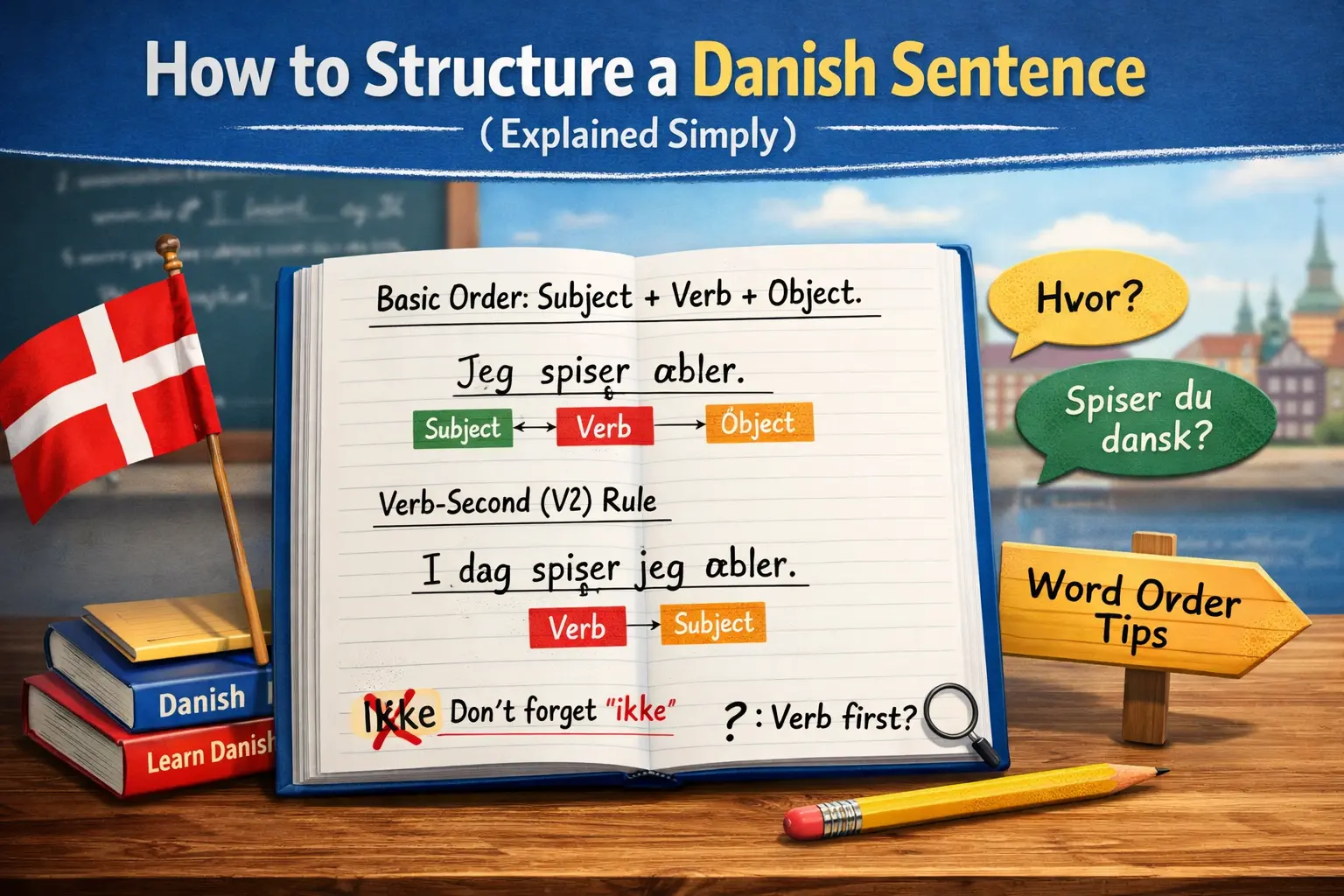
Danish sentence structure can feel confusing at first, especially because it does not always follow the same word order as English. The good news is that Danish rules are very consistent once you understand the basics of the "V2 Rule."
In this guide, you will learn how Danish sentences are structured, when the word order changes (inversion), and what mistakes beginners commonly make.
Basic Danish Sentence Order (SVO)
In simple, straightforward sentences, Danish uses the same basic structure as English: Subject – Verb – Object (SVO).
- Jeg spiser æbler. (I eat apples)
- Hun læser en bog. (She reads a book)
The Verb-Second (V2) Rule
Danish follows the V2 rule. This is the "Golden Rule" of Danish grammar: the conjugated verb must always be the second element in a main clause.
If the sentence starts with a time word, a location, or an adverb instead of the subject, the verb must still stay in second place. This causes the subject to move to the third position (Inversion).
| Position 1 (Start) | Position 2 (Verb) | Position 3 (Subject) | Rest of sentence |
|---|---|---|---|
| Jeg (Subject) | bor | — | i København. |
| Nu (Time) | bor | jeg | i København. |
💡 Grammar Tip
Since the verb is the most important part of the V2 rule, you need to know your conjugations! Explore over 100+ verbs in our Danish Verb Directory to practice your sentence building.
Questions in Danish
For yes/no questions, Danish places the verb first. For question-word (hv-) questions, the question word is the first element, followed immediately by the verb.
- Spiser du æbler? (Do you eat apples? — Verb First)
- Hvorfor lærer du dansk? (Why are you learning Danish? — V2 Rule)
Where to Place “ikke” (Not)
In a standard main clause, the negation ikke usually comes after the verb and the subject.
- Jeg spiser ikke kød. (I do not eat meat)
- I dag spiser jeg ikke kød. (Today I do not eat meat)
Main clauses and subordinate clauses
The V2 rule applies to a main clause, but the word order changes after words such as fordi (because), at (that), and når (when). In a subordinate clause, ikke usually comes before the conjugated verb: Jeg bliver hjemme, fordi jeg ikke har det godt (I stay home because I do not feel well). This contrast is easier to remember when you mark the clause boundary instead of memorizing isolated positions.
- Main clause: I dag arbejder jeg ikke hjemme.
- Subordinate clause: fordi jeg ikke arbejder hjemme.
A sentence-building drill
Start with a simple subject-verb sentence, then add one element at a time. For example: Jeg læser, Jeg læser dansk, I dag læser jeg dansk, and finally I dag læser jeg dansk på biblioteket. Say each version aloud and point to the conjugated verb. Then turn the final sentence into a question and a negative sentence. This drill makes word order active instead of leaving it as a rule you only recognize while reading.
Quick practice
- Move I morgen to the front of Jeg arbejder på hospitalet.
- Make Du taler dansk into a yes/no question.
- Join Jeg går hjem and jeg er træt with fordi.
Possible answers: I morgen arbejder jeg på hospitalet, Taler du dansk?, and Jeg går hjem, fordi jeg er træt.
Common Mistakes to Avoid
- Using English word order: Saying "I dag jeg spiser" instead of "I dag spiser jeg."
- Moving the verb: Thinking the verb must always follow the subject. In Danish, the verb follows the position, not the person.
- Ikke placement: Putting "ikke" before the verb in a main clause.
Practice Makes It Stick
The best way to master Danish sentence structure is to build your own sentences every day. Reading rules is a start, but your brain needs to "feel" the verb in the second position.
Practice Vocabulary & Sentences
Ready for the rest of Danish grammar – gender, verbs and adjectives? See our complete Danish grammar guide, with every rule explained and free exercises for each topic.
Danish sentence structure follows logic. Once you lock in the V2 rule, you have unlocked 80% of Danish grammar!