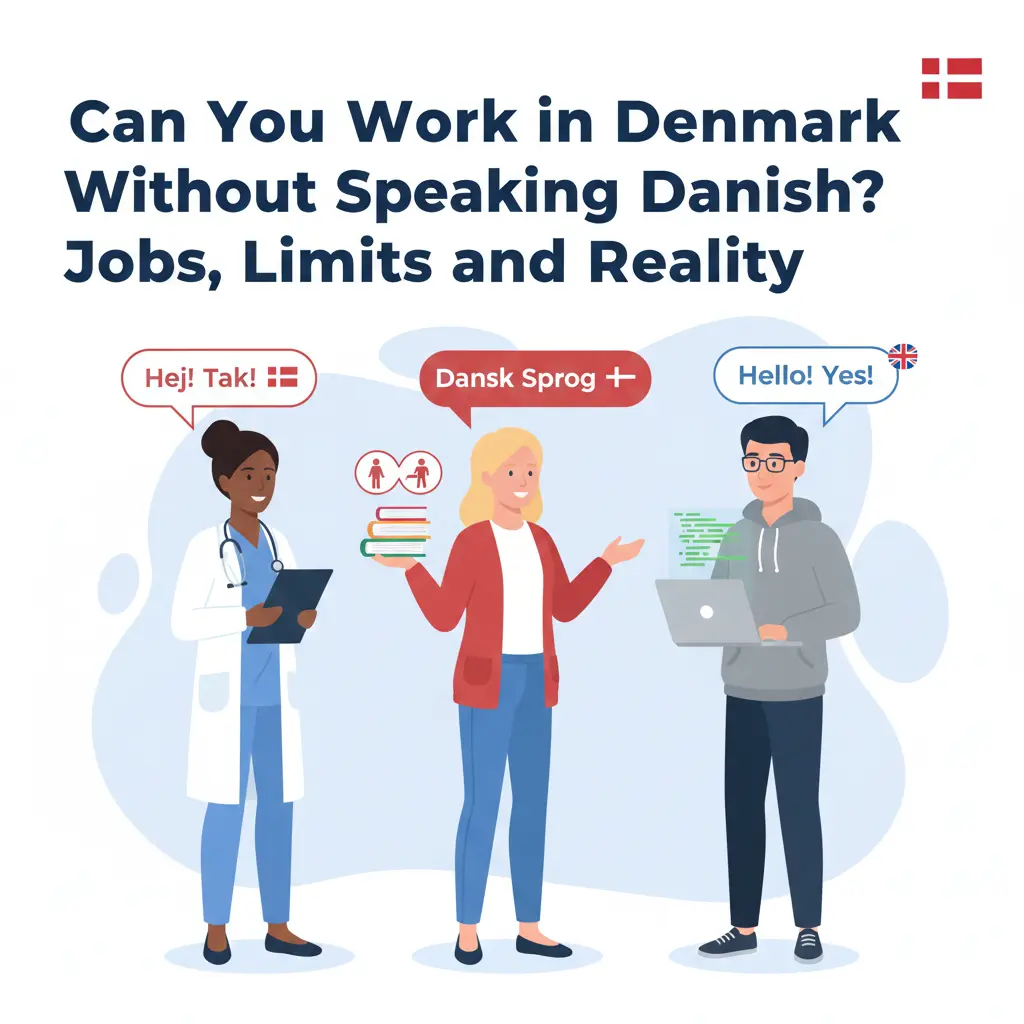
Many people planning to move to Denmark ask the same question: Can I work in Denmark without speaking Danish?The short answer is yes — but only in certain jobs and usually only at the beginning.
In this article, we explain which jobs may not require Danish at first, which professions clearly do, and what the long-term reality looks like.
Jobs Where Danish Is Usually Required
Professions that involve daily communication with citizens, patients, or children almost always require Danish. This is mainly for safety, legal, and communication reasons.
- Nurses: Nurses must communicate clearly with patients, doctors, and families. Since 1 July 2025, nurses educated outside the EU/EEA must pass Prøve i Dansk 3 (B2) with at least 10 in oral, 7 in reading and 7 in written communication as part of Danish authorisation.
- Pedagogues (childcare and education): Pedagogues work closely with children and parents. Danish is essential for guidance, safety, and emotional support.
- Healthcare and social workers: Most healthcare roles require Danish for legal documentation and patient communication.
Jobs Where Danish Is Often Not Required at First
Some international roles use English as the working language, especially in global or technical environments.
- IT and software development: Many tech companies in Denmark operate fully in English. Danish may not be required for daily work.
- Engineering and research: International teams often use English, especially in universities and startups.
- Corporate roles in global companies: Some finance, marketing, and operations roles use English internally.
The Long-Term Reality
Even if Danish is not required at the start, learning it becomes important over time. Danish helps with:
- Career growth and promotions
- Understanding workplace culture
- Permanent residence (Prøve i Dansk 2 is a basic requirement) and citizenship (generally Prøve i Dansk 3)
- Daily life outside of work
A practical job-search checklist
Read the language requirement carefully instead of assuming that “English-speaking workplace” means Danish is irrelevant. Check whether the role involves customers, citizens, patient records, safety instructions, or public administration. Search for phrases such as arbejdssprog er engelsk (the working language is English), but also look for “Danish is an advantage” and “willingness to learn Danish.” Those phrases often describe the real expectation more accurately than a simple yes-or-no requirement.
- Prepare an English application while showing a concrete Danish study plan.
- Learn the vocabulary used in the job description before the interview.
- Practise explaining that you can work in English and are actively learning Danish.
- Ask the employer how language is used in meetings, documentation, and customer contact.
A useful first workplace phrase
Kan du sige det lidt langsommere? means “Could you say that a little more slowly?” Learning repair phrases like this helps you participate before your vocabulary is complete.
Can You Build a Career Without Danish?
It is possible to work short-term or mid-term without Danish in specific fields like IT. However, for most people who plan to stay long-term, learning Danish becomes necessary.
How to Start Learning Danish the Right Way
A strong foundation in grammar, sentence structure, and reading helps learners progress faster toward exams like PD3 and professional language use.
At LearnDanishLab, we focus on clear explanations and practical Danish that supports real-life goals such as work, exams, and integration.
Final Thoughts
You can work in Denmark without Danish in some roles, but Danish opens far more opportunities. Starting early gives you a clear advantage.
This article is for informational purposes only. Requirements may change, so always check official Danish authorities and employers.
Official sources
Rules change. Always confirm with these official sources before making decisions. Last checked: 4 October 2026.
- Work in Denmark – the Danish public service for international job seekers and employers.
- New to Denmark: Work permits – official work and residence permit schemes.
- Danish Patient Safety Authority: Language test for nurses (non-EU) – the Danish language requirement for nurses educated outside the EU/EEA.
- New to Denmark: Permanent residence – conditions for permanent residence, including the Danish language requirements.
- Ministry of Immigration and Integration: Danish skills for citizenship – the Danish language requirement for Danish citizenship (in Danish).