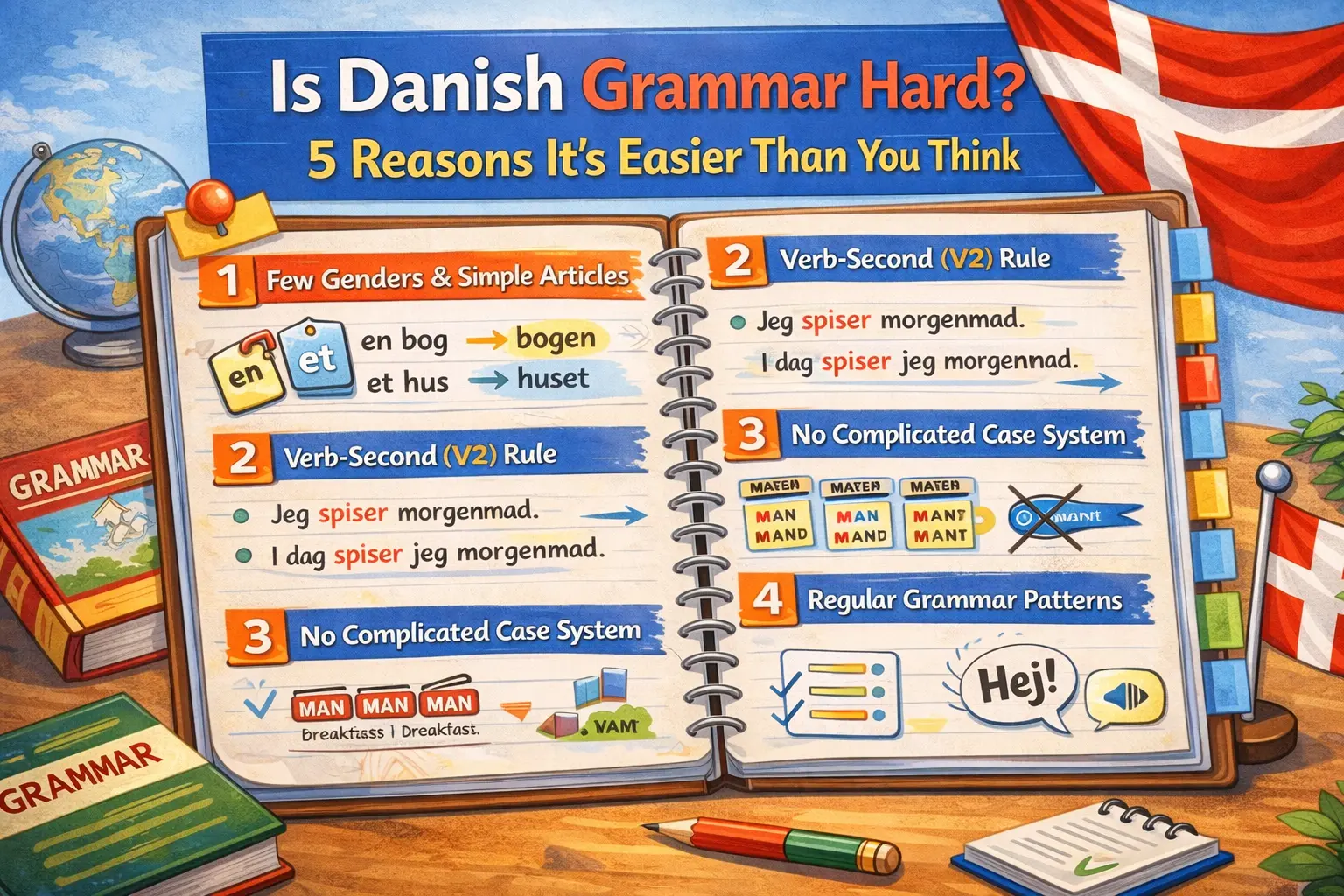
Many new learners of Danish wonder: “Is Danish grammar really hard?” The honest answer is that some parts are surprisingly easy, especially for English speakers, while a few parts need patient practice. Knowing which is which helps you spend your study time where it matters.
In this article, we look at four reasons Danish grammar is easier than it looks, the parts that really are tricky, and a short quiz so you can check yourself.
1. Verbs Do Not Change for the Person
This is the biggest gift Danish gives you. In English you say “I eat” but “she eats”. In German or French the verb changes for almost every person. In Danish, the present tense is the same for everyone:
- Jeg spiser – I eat
- Du spiser – you eat
- Hun spiser – she eats
- Vi spiser – we eat
- De spiser – they eat
Almost every present-tense verb ends in -r: spiser, går, har, er. Learn one form and you can use it with every person. Explore more verbs in ourDanish Verb Directory.
2. Only Two Genders, and No Noun Cases
Danish nouns are either en words (common gender) or et words (neuter). About three out of four nouns are en words, so en is a good guess when you are unsure.
| Feature | German | Danish |
|---|---|---|
| Genders | 3 (masculine, feminine, neuter) | 2 (common en, neuter et) |
| Noun cases | 4 (nominative, accusative, dative, genitive) | None, apart from possessive -s (Peters bil) |
| Pronouns | Change by case | Change like English: jeg → mig, han → ham, vi → os |
Some endings also give useful clues. Nouns ending in -ing, -hed, -else and -ion are usually en words (en regning, en frihed, en følelse, en station), while nouns ending in -um are usually et words (et museum, et centrum).
3. “The” Goes on the End of the Word
Instead of a separate word for “the”, Danish adds an ending: en bog → bogen (the book), et hus → huset (the house), bøger → bøgerne (the books). It feels strange for a week, then it becomes automatic.
One rule to learn early: when there is an adjective, “the” moves to the front as a separate word, and the adjective gets an -e: den store bog (the big book), det store hus (the big house), de store bøger (the big books).
4. Word Order Follows Clear Rules
In main clauses the verb comes second (the V2 rule). If you start the sentence with something other than the subject, the subject moves after the verb:
- ✅ Jeg spiser morgenmad. – I eat breakfast.
- ✅ I dag spiser jeg morgenmad. – Today I eat breakfast.
- ✅ Spiser du morgenmad? – Do you eat breakfast?
See many more examples in ourguide to Danish sentence structure.
The Parts That Really Are Tricky
Danish grammar is friendly, but not effortless. These are the areas where learners usually need extra practice:
- Learning en or et for each noun. The endings above help, but many words must simply be learned, for example en stol (a chair) but et bord (a table). Always learn new nouns with their article.
- Irregular plurals. Most plurals add -er or -e, but common words break the pattern: en mand → mænd, et barn → børn, en bog → bøger, en fod → fødder.
- Irregular verbs in the past tense. Regular verbs add -ede or -te (lavede, spiste), but everyday verbs are irregular: gå – gik – gået, være – var – været, få – fik – fået.
- Adjective endings. The pattern is simple once you see it: en stor bil, et stort hus, store biler. The -t for et words is the one learners forget most.
- Word order in subordinate clauses. Words like ikke (not) come before the verb after at, fordi, når and similar words: Han kommer ikke but Jeg ved, at han ikke kommer.
Quick quiz: test yourself
- Put the words in order: i går / jeg / gik / i biografen (start with I går).
- What is “the apple” if “an apple” is et æble?
- Fill in ny (new): en ___ bil and et ___ hus.
- Fill in the pronoun: Kan du hjælpe ___? (me)
- Where does ikke go? Jeg tror, at hun kommer. (I think that she is not coming.)
Show answers
- I går gik jeg i biografen. The verb stays in second place.
- æblet
- en ny bil, et nyt hus
- Kan du hjælpe mig?
- Jeg tror, at hun ikke kommer.
Tips for Learning Danish Grammar Easily
- Learn every noun with en or et, and its plural, from the first day.
- Learn irregular verbs as three-word sets: gå – gik – gået.
- Practise word order with our guide on sentence structure.
- Read our article on what makes Danish grammar unique for more examples.
Want to work through it step by step? See our complete Danish grammar guide, with every rule explained and free exercises for each topic.
Danish grammar is logical and, in many ways, simpler than other Germanic languages. Spend your effort on genders, irregular forms and word order, and the rest will follow.