How to Improve Danish Vocabulary (From Someone Who Struggled for Months)
If you're trying to improve Danish vocabulary, you've probably experienced this cycle: You learn 20 new words today. Tomorrow, you remember 3. You finally memorize a noun. Then you forget whether it's en or et.
I know this because I lived it. I didn't create Learn Danish Lab as a side project or content experiment. I built it out of frustration. I moved to Denmark as an international professional, motivated and optimistic, and quickly ran into a wall. It wasn't grammar. It wasn't effort. It was vocabulary.
This article is both my personal journey and a practical masterclass on how to improve Danish vocabulary efficiently, especially if you are:
- An international professional working full-time
- A university student navigating academic and social Danish
- Someone preparing for PD3 or Studieprøven
- Or planning to move to Denmark and wanting a serious head start
If vocabulary feels like your bottleneck, this will give you a structured way forward.
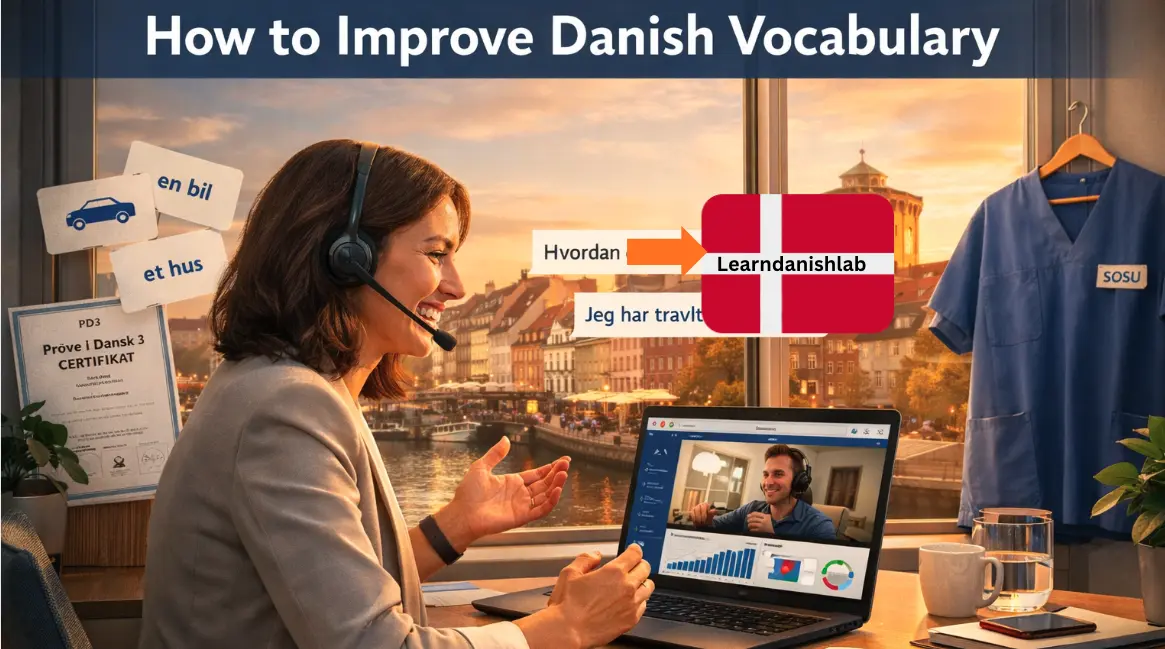
Why Is Danish Vocabulary So Hard?
Before we fix the problem, we need to understand it. Most learners blame themselves. The issue usually isn't intelligence or motivation. It's structure.
1. The Forgetting Curve Is Not Your Fault
Psychologist Hermann Ebbinghaus demonstrated what is now known as the forgetting curve. Without reinforcement, we forget most newly learned information within days.
That explains why:
- Cramming before class feels productive
- You feel confident immediately after studying
- 48 hours later, everything is gone
If you are not using spaced repetition and active recall, you are working against how memory actually functions.
When I first started Danish classes, I would learn 20–30 words per week. By the following week, maybe 5 survived. It felt like I was making no progress despite putting in hours.
2. Danish Pronunciation Disrupts Pattern Learning
In many languages, spelling gives you reliable pronunciation clues. In Danish, that connection is weak.
Take a word like arbejde. If you're new, the spelling gives almost no help for pronunciation. Silent letters, swallowed syllables, and soft consonants make auditory recognition difficult.
This creates a second problem: your brain struggles to connect written vocabulary with spoken Danish. So even if you recognize the word on paper, you may not recognize it in conversation.
3. The "En/Et" Problem Creates Cognitive Overload
You cannot construct even basic correct sentences without mastering noun gender. But most tools teach vocabulary like this:
- hus → house
- bil → car
And only later add gender as an afterthought. That is inefficient.
If you don't automate noun gender, every sentence becomes mentally expensive. You hesitate. You second-guess. You sound unsure.
Examples:
- en bil
- et hus
- en mulighed
- et spørgsmål
If these aren't automatic, your speaking speed will never improve. For me, this was one of the biggest psychological barriers. Getting en/et wrong felt like being marked as a beginner instantly.
4. Speed Shock in Real Conversations
Textbook Danish is clean and clearly articulated. Real Danish is compressed. Native speakers blend words. Sounds disappear. Endings soften. Especially in Copenhagen, the pace can feel overwhelming.
I remember understanding 90 percent of a written dialogue in class. Then hearing a similar conversation in real life and catching maybe 30 percent. Vocabulary that is not deeply encoded collapses under speed pressure.
What Failed for Me (And Why It Might Be Failing for You)
Let's be honest about what doesn't work long-term.
Passive Reading
I spent weeks reading Danish texts and word lists. My eyes scanned the page. My brain did not encode the vocabulary.
Recognition is not recall. Just because something looks familiar does not mean you can retrieve it in conversation.
Only Using Apps Like Duolingo
These platforms are excellent for consistency and beginner exposure. But they often allow you to "win" exercises without deeply processing vocabulary.
- You choose from multiple-choice options.
- You rearrange words that are already given to you.
That builds recognition, not retrieval. And retrieval is what you need in real conversation.
Cramming Before Class
I would intensely review vocabulary right before lessons. For an hour, I felt productive. Two days later, it was gone.
Without spaced repetition, information leaks out quickly. Learning felt like pouring water into a bucket with holes in it.
The Shift That Changed Everything
The turning point came when I stopped consuming vocabulary and started struggling with it.
Instead of reading words repeatedly, I forced myself to retrieve them from memory. That is what cognitive science calls active recall.
The 3 Best Methods to Improve Danish Vocabulary
These are not theoretical. These are what actually worked for me.
1. Active Recall with Spaced Repetition
This is where tools like Anki changed everything for me. But here is the key: I did not use single-word flashcards.
Bad card:
Front: hus
Back: house
Better card:
Front:
Jeg bor i ___ hus.
Back:
et hus
audio
full example sentence
This format forced me to:
- Recall the word
- Recall the gender
- Recall usage
- Connect written and spoken forms
Results:
- From struggling to retain 20 words per week
- To consistently retaining 50+ words per week
- Building 1,000+ active vocabulary items in 6 months
The difference was not more time. It was better structure.
2. Shadowing Danish Media
I began watching Danish series on DR TV with Danish subtitles.
Then I paused. Repeated lines aloud. Mimicked pronunciation and rhythm.
This helped me:
- Adjust to real speech speed
- Internalize intonation
- Connect vocabulary to sound
Vocabulary that lives only on paper is fragile. Vocabulary connected to rhythm and sound is durable.
3. Deliberate Interactive Practice
This was the biggest breakthrough.
Instead of reviewing lists, I created exercises that forced decision-making:
- Choose the correct en/et
- Select the correct verb form
- Fill in sentence gaps
- Use vocabulary in context
That friction is what makes memory stick.
You do not learn a word by seeing it. You learn it by retrieving it under small amounts of pressure.
This principle became the foundation for Learn Danish Lab's Interactive Practice Hub.
The 15-Minute Daily Routine That Scales
Many learners think they need hours per day. You don't. You need consistency and structure.
| Time | Activity |
|---|---|
| Minute 1–5 | Spaced repetition review (sentence-based cards only) |
| Minute 6–10 | Interactive exercises targeting one weakness |
| Minute 11–15 | Speak 5–10 sentences out loud using the day's vocabulary |
That's it. Short. Focused. Daily.
Want a structured way to practice? Explore our Danish Practice Modules designed around this exact routine.
The "SOSU Experiment" (A Case Study)
Recently, I built a healthcare vocabulary module focused on SOSU assistants. To test effectiveness, I used only 15 minutes per day for one week.
The focus:
- High-frequency phrases
- Context-based exercises
- Sentence-level retrieval
After 7 days, I could recall and correctly use roughly 90 percent of the target vocabulary in simulated conversations.
The lesson was clear:
Short, active, structured practice beats long, passive sessions.
If you work in healthcare, check out our Danish Phrases for Healthcare module.
How to Learn Danish En/Et Nouns Faster
If you struggle with noun gender, change your structure immediately.
Never learn a noun alone.
Wrong:
hus → house
Correct:
et hus
Even better:
Jeg bor i et hus.
Your brain stores patterns, not isolated data points. You want automaticity.
When you see "hus," the word "et" should appear instantly.
Practice Technique:
- Create two columns: EN and ET
- Add new nouns daily to the correct column
- Review by covering the gender and testing yourself
For structured en/et practice, try the exercises in our Interactive Practice Hub.
Active Recall Language Learning: Why It Works
Active recall forces your brain to reconstruct information. Reconstruction strengthens neural pathways more than re-reading does.
Every time you successfully retrieve:
- A noun
- A verb form
- A phrase
You increase the likelihood of future retrieval.
The Science:
Research by Karpicke and Roediger (2008) demonstrated that students who practiced active recall retained 50% more information after one week compared to those who simply restudied material.
Passive exposure feels comfortable. Active recall feels slightly uncomfortable.
That discomfort is growth.
The B1 Breakthrough Framework (3 Months)
If you feel stuck between A2 and B1, structure your next 12 weeks like this.
Month 1: Thematic Vocabulary
Choose one theme per week:
- Work
- Healthcare
- Education
- Social interactions
Learn 50 high-frequency words per week. Only in context.
By the end of the month: 200 words deeply encoded.
Month 2: Controlled Output
- Write 5 short paragraphs per week
- Record yourself speaking twice weekly
- Intentionally track and correct en/et mistakes
This converts passive vocabulary into active vocabulary.
Month 3: Simulation
- 15-minute conversation simulations
- Topic-based drills
- Real-time recall under light pressure
This builds fluency.
The shift happens when vocabulary moves from recognition to automatic production.
My Current Level (And Why I'm Still Improving)
I am currently at a solid B1, approaching B2.
I can:
- Handle work discussions
- Discuss plans and opinions
- Navigate daily life comfortably
But my goal is C1 fluency. That means nuance. Humor. Cultural depth. Effortless participation.
The method I described continues to work at higher levels because it is built on cognitive principles, not shortcuts.
Danish Vocabulary by CEFR Level: What You Need to Know
Understanding what's expected at each level helps you set realistic goals and track progress effectively.
A1 Level (Beginner): 500-700 Words
Basic greetings, numbers, everyday objects, present tense.
Can do: Introduce yourself, order food, ask simple questions.
A2 Level (Elementary): 700-1,200 Words
Family, work, routines, past tense introduction.
Can do: Describe background, talk about hobbies, handle transactions.
B1 Level (Intermediate): 1,500-2,500 Words
Opinions, future plans, work topics, all verb tenses.
Can do: Discuss abstract topics, handle work situations, express opinions.
B2 Level (Upper Intermediate): 2,500-4,000 Words
Abstract concepts, idioms, professional vocabulary.
Can do: Participate in meetings, understand complex texts, express fluently.
C1 Level (Advanced): 5,000-8,000 Words
Specialized terminology, humor, regional variations.
Can do: Understand implicit meaning, use language flexibly.
C2 Level (Mastery): 10,000+ Words
All registers, cultural literacy, professional mastery.
Native-like command.
Track your progress with our Vocabulary Assessment Tool to identify your current CEFR level.
15 Vocabulary Themes with Example Sentences
To build depth, focus on thematic vocabulary. Here are 15 essential themes with example sentences you can practice today.
1. Work and Career (Arbejde og Karriere)
| Danish | English | Example Sentence |
|---|---|---|
| et job | a job | Jeg har fået et nyt job. |
| en kollega | a colleague | Mine kollegaer er meget hjælpsomme. |
| et møde | a meeting | Vi har møde klokken 10. |
| en opgave | a task | Denne opgave er svær. |
| en deadline | a deadline | Deadline er på fredag. |
2. Healthcare and Body (Sundhed og Krop)
| Danish | English | Example Sentence |
|---|---|---|
| en læge | a doctor | Jeg skal til lægen i morgen. |
| en sygeplejerske | a nurse | Sygeplejersken var meget sød. |
| en patient | a patient | Patienten har ondt i hovedet. |
| en medicin | medication | Jeg skal tage medicin hver dag. |
| en undersøgelse | an examination | Undersøgelsen tager 30 minutter. |
For more healthcare vocabulary, visit our SOSU Danish Phrases module.
3. Education (Uddannelse)
| Danish | English | Example Sentence |
|---|---|---|
| et universitet | a university | Jeg studerer på Københavns Universitet. |
| en underviser | a teacher | Vores underviser er meget dygtig. |
| en eksamen | an exam | Jeg skal til eksamen i næste uge. |
| en opgave | an assignment | Jeg skriver en opgave om dansk kultur. |
| et kursus | a course | Dette kursus er for begyndere. |
4. Social Life (Socialt Liv)
| Danish | English | Example Sentence |
|---|---|---|
| en ven | a friend | Jeg mødte mine venner i går. |
| en fest | a party | Der var mange mennesker til festen. |
| en samtale | a conversation | Vi havde en god samtale. |
| en invitation | an invitation | Jeg fik en invitation til brylluppet. |
| en oplevelse | an experience | Det var en fantastisk oplevelse. |
5. Food and Dining (Mad og Spisning)
| Danish | English | Example Sentence |
|---|---|---|
| morgenmad | breakfast | Jeg spiser morgenmad klokken 7. |
| frokost | lunch | Vi mødes til frokost i kantinen. |
| aftensmad | dinner | Hvad skal vi have til aftensmad? |
| en restaurant | a restaurant | Lad os spise på en restaurant i aften. |
| en opskrift | a recipe | Jeg prøvede en ny opskrift i går. |
6. Transportation (Transport)
| Danish | English | Example Sentence |
|---|---|---|
| en bus | a bus | Bussen kommer om 5 minutter. |
| et tog | a train | Toget til Aarhus kører fra spor 3. |
| en bil | a car | Jeg køber måske en bil næste år. |
| en cykel | a bike | De fleste danskere har en cykel. |
| en station | a station | Vi mødes på stationen. |
7. Housing (Bolig)
| Danish | English | Example Sentence |
|---|---|---|
| en lejlighed | an apartment | Jeg bor i en lejlighed på Nørrebro. |
| et hus | a house | De købte et hus i forstaden. |
| et værelse | a room | Hun lejer et værelse ud. |
| en nabo | a neighbor | Mine naboer er meget stille. |
| husleje | rent | Huslejen stiger næste måned. |
8. Shopping (Indkøb)
| Danish | English | Example Sentence |
|---|---|---|
| en butik | a shop | Den butik har gode tilbud. |
| et supermarked | a supermarket | Jeg handler i Netto hver uge. |
| pris | price | Prisen er rimelig. |
| en rabat | a discount | Får jeg rabat som studerende? |
| at betale | to pay | Jeg betaler med kort. |
9. Weather and Nature (Vejr og Natur)
| Danish | English | Example Sentence |
|---|---|---|
| vejret | the weather | Vejret er dårligt i dag. |
| regn | rain | Det ser ud til regn. |
| sol | sun | Solen skinner i dag. |
| vind | wind | Der er meget vind i dag. |
| en skov | a forest | Vi gik en tur i skoven. |
10. Emotions (Følelser)
| Danish | English | Example Sentence |
|---|---|---|
| glad | happy | Jeg er så glad i dag! |
| trist | sad | Filmen var lidt trist. |
| stresset | stressed | Jeg er lidt stresset på grund af arbejde. |
| træt | tired | Jeg er meget træt i aften. |
| spændt | excited/nervous | Jeg er spændt på at starte. |
11. Technology (Teknologi)
| Danish | English | Example Sentence |
|---|---|---|
| en computer | a computer | Min computer er gået i stykker. |
| en telefon | a phone | Jeg har glemt min telefon derhjemme. |
| internettet | the internet | Internettet er langsomt i dag. |
| en app | an app | Den her app er virkelig nyttig. |
| en hjemmeside | a website | Vores hjemmeside har fået et nyt design. |
12. Family (Familie)
| Danish | English | Example Sentence |
|---|---|---|
| en mor | a mother | Min mor ringer hver søndag. |
| en far | a father | Min far er ingeniør. |
| en bror | a brother | Jeg har to brødre. |
| en søster | a sister | Min søster bor i Jylland. |
| et barn | a child | Vi har tre børn. |
13. Time and Dates (Tid og Datoer)
| Danish | English | Example Sentence |
|---|---|---|
| i dag | today | I dag er det mandag. |
| i morgen | tomorrow | Vi ses i morgen! |
| i går | yesterday | I går var det solskin. |
| en uge | a week | Jeg er her i en uge. |
| en måned | a month | Om en måned rejser jeg. |
14. Hobbies and Interests (Hobbyer og Interesser)
| Danish | English | Example Sentence |
|---|---|---|
| at læse | to read | Jeg elsker at læse romaner. |
| at løbe | to run | Jeg løber en tur hver morgen. |
| at synge | to sing | Hun synger i et kor. |
| at rejse | to travel | Vi rejser gerne til udlandet. |
| at lave mad | to cook | Han elsker at lave mad. |
15. Politics and Society (Politik og Samfund)
| Danish | English | Example Sentence |
|---|---|---|
| en lov | a law | Der er kommet en ny lov. |
| en stemme | a vote | Jeg afgav min stemme i går. |
| et parti | a political party | Hvilket parti stemmer du på? |
| samfundet | society | Det er vigtigt for samfundet. |
| en borger | a citizen | Alle borgere har rettigheder. |
Practice these themes with our thematic vocabulary exercises.
Interviews with 3 Successful Danish Learners
Real stories from real learners who improved their Danish vocabulary using active methods.
Interview 1: Maria, 34, IT Consultant from Spain
Background: Moved to Copenhagen 3 years ago with zero Danish knowledge.
Biggest challenge: "Pronunciation, especially the soft D's. I couldn't hear the difference between 'mad' (food) and 'mat' (math)."
What worked: "I committed to 20 minutes of active recall every morning before work. No exceptions. I used sentence cards and recorded myself saying each word."
Vocabulary growth: From 200 words to 2,500 words in 18 months.
Advice for beginners: "Don't wait until you feel 'ready' to speak. I started speaking on day one, even though it was terrible. The embarrassment was worth it."
Interview 2: Thomas, 28, PhD Student from Germany
Background: Came to Denmark for doctoral studies at Aarhus University.
Biggest challenge: "Academic vocabulary. I could handle everyday conversation, but discussing my research in Danish was impossible."
What worked: "I created a specialized deck with 500 academic terms and phrases from my field. I also started reading Danish research papers aloud."
Breakthrough moment: "After 6 months of this focused practice, I presented part of my research at a department meeting in Danish. I wasn't fluent, but I was understood."
Vocabulary system: "I use a modified version of the 15-minute routine, but I spend 10 minutes on academic vocabulary and 5 on general conversation."
Interview 3: Emma, 42, Nurse from the Philippines
Background: Recruited to work as a nurse in a Danish hospital.
Biggest challenge: "Medical terminology and communicating with patients under pressure. You can't hesitate when someone needs help."
What worked: "I focused entirely on healthcare scenarios. I practiced dialogues with colleagues during breaks and used medical flashcard decks."
Results: Passed the Danish language exam for healthcare professionals after 8 months.
Current level: B2, working toward C1.
Her philosophy: "Learn what you need first. General vocabulary can come later. For me, patient safety came first."
Visit our learner success stories for more inspiration.
Pronunciation Guide: 50 Difficult Danish Words
Danish pronunciation is notoriously challenging. Here are 50 words that frequently trip learners up, with pronunciation guides.
The Soft D (Blødt D)
| Word | Meaning | Pronunciation Guide |
|---|---|---|
| mad | food | meh-th (soft th, like English "the") |
| bad | bath | beh-th |
| bedst | best | best (almost silent d) |
| rød | red | reuth (soft th) |
| gade | street | geh-thuh |
The Stød (Glottal Stop)
| Word | Meaning | Pronunciation Guide |
|---|---|---|
| hund | dog | hun' (with a stop in the throat) |
| mand | man | man' |
| ånd | spirit | ohn' |
| spiser | eats | spee'ser |
| læser | reads | leh'ser |
Vowel Challenges
| Word | Meaning | Pronunciation Guide |
|---|---|---|
| øl | beer | ul (like English "pull" but rounded) |
| øv | darn | uhv |
| syv | seven | su (silent v) |
| tyve | twenty | tue (silent v) |
| Hvad | what | veh (h is silent) |
| Hvor | where | vor (h is silent) |
| Hvem | who | vem (h is silent) |
| Hvordan | how | vordan (h is silent) |
Common Tricky Words
| Word | Meaning | Pronunciation Guide |
|---|---|---|
| arbejde | work | ah-byeh (very soft d) |
| købe | buy | kuh-beh |
| smørrebrød | open sandwich | smuhr-bruth |
| rødgrød | red porridge | ruth-gruth (ultimate tongue twister) |
| fløj | flew | floy (like English "boy") |
| bøjle | hanger | boy-leh |
| søster | sister | suh-ster |
| bror | brother | bror (rolled r) |
| far | father | far (rolled r) |
| mor | mother | mor (rolled r) |
Numbers (Especially Tricky)
| Word | Meaning | Pronunciation Guide |
|---|---|---|
| halvtreds | 50 | hal-tress |
| tres | 60 | tress |
| halvfjerds | 70 | hal-fyerrs |
| firs | 80 | feers |
| halvfems | 90 | hal-fems |
Silent Letters
| Word | Meaning | Pronunciation Guide |
|---|---|---|
| dag | day | dah (g is silent) |
| morgen | morning | morn (g silent, like English) |
| bjerg | mountain | byeh (g silent) |
| selv | self | sel (v silent) |
| giv | give | gee (v silent) |
| tag | take | tah (g silent) |
Practice these pronunciations with our audio exercises featuring native Danish speakers.
Weekly Vocabulary Tracker Template
Consistent tracking is essential for vocabulary growth. Here's the exact template I use.
Weekly Vocabulary Tracker
Week of: _______________ Theme: _________________
Daily Log
| Day | New Words Learned | Words Reviewed | En/Et Accuracy | Notes |
|---|---|---|---|---|
| Monday | _____ | _____ | ___% | _______________ |
| Tuesday | _____ | _____ | ___% | _______________ |
| Wednesday | _____ | _____ | ___% | _______________ |
| Thursday | _____ | _____ | ___% | _______________ |
| Friday | _____ | _____ | ___% | _______________ |
| Saturday | _____ | _____ | ___% | _______________ |
| Sunday | _____ | _____ | ___% | _______________ |
Weekly Summary
Total new words this week: _______________
Cumulative total: _______________
Average en/et accuracy: _______________
Words to Review Next Week
| Word | Gender | Sentence Example | Needs Work? |
|---|---|---|---|
| _________ | en/et | _________ | ☐ |
| _________ | en/et | _________ | ☐ |
| _________ | en/et | _________ | ☐ |
| _________ | en/et | _________ | ☐ |
Reflection Questions
- Which theme worked best this week? _________________
- What was my biggest challenge? _________________
- What will I do differently next week? _________________
Download the printable PDF version of this tracker.
30-Day Danish Vocabulary Challenge
Ready to transform your vocabulary in one month? Here's a day-by-day challenge designed for maximum results.
Week 1: Foundation (Days 1–7)
Goal: Establish the habit and master 100 essential words.
| Day | Focus | Task |
|---|---|---|
| Day 1 | Greetings & Basics | Learn 15 essential phrases. Practice saying them aloud 10 times. |
| Day 2 | Numbers 1–20 | Create sentence cards for each number (Jeg har __ bøger). |
| Day 3 | Days & Months | Write this week's schedule in Danish. |
| Day 4 | Family Words | Learn 15 family terms. Record yourself saying them. |
| Day 5 | En/Et Introduction | Create 20 noun cards WITH gender. |
| Day 6 | Common Verbs | Learn 15 present tense verbs in sentences. |
| Day 7 | Review Day | Review all 100 words. Note which need more work. |
Week 2: Thematic Expansion (Days 8–14)
Goal: Build themed vocabulary sets.
| Day | Focus | Task |
|---|---|---|
| Day 8 | Food & Drink | Learn 20 food items. Create shopping list in Danish. |
| Day 9 | Restaurant Phrases | Practice ordering food dialogue 5 times. |
| Day 10 | Clothing | Learn 15 clothing words. Describe what you're wearing. |
| Day 11 | Home & Furniture | Label items in your home with sticky notes. |
| Day 12 | Transportation | Learn 15 transport words. Plan a trip in Danish. |
| Day 13 | Weather | Learn 10 weather expressions. Check forecast in Danish. |
| Day 14 | Review Day | Active recall test on all words from Week 2. |
Week 3: Grammar Integration (Days 15–21)
Goal: Connect vocabulary to grammar patterns.
| Day | Focus | Task |
|---|---|---|
| Day 15 | En/Et Deep Dive | Review 50 nouns. Test yourself on gender only. |
| Day 16 | Plural Forms | Learn plural patterns for 20 nouns. |
| Day 17 | Adjectives | Learn 15 common adjectives with en/et forms (stor, stort). |
| Day 18 | Verb Tenses | Practice 10 verbs in past tense sentences. |
| Day 19 | Word Order | Write 10 sentences using new vocabulary with correct word order. |
| Day 20 | Prepositions | Learn 10 common prepositions with examples. |
| Day 21 | Review Day | Write a short paragraph using Week 3 vocabulary. |
Week 4: Active Production (Days 22–30)
Goal: Move from recognition to active use.
| Day | Focus | Task |
|---|---|---|
| Day 22 | Speaking Practice | Record 2-minute monologue about your day. |
| Day 23 | Listening Practice | Watch 15 minutes of Danish TV without subtitles. |
| Day 24 | Writing Practice | Write 10 sentences about your weekend plans. |
| Day 25 | Conversation Simulation | Practice dialogue with yourself (interview format). |
| Day 26 | News in Danish | Read one short news article, note 10 new words. |
| Day 27 | Music | Find a Danish song, learn lyrics, sing along. |
| Day 28 | Review All | Comprehensive review of all 400+ words. |
| Day 29 | Self-Assessment | Identify weakest areas for continued focus. |
| Day 30 | Celebration | Have a real conversation with a Danish speaker! |
Track your 30-day journey with our challenge workbook.
Regional Vocabulary Differences: Zealand vs. Jutland
Danish isn't uniform across Denmark. Here are key vocabulary differences between Copenhagen (Zealand) and Jutland.
Everyday Words
| English | Copenhagen (Standard) | Jutland (Regional) |
|---|---|---|
| I | jeg | æ |
| you (plural) | I | I (different pronunciation) |
| not | ikke | itj |
| what | hvad | hva' |
| potato | kartoffel | kartoffel (different pronunciation) |
| girl | pige | tøs (also used informally in Copenhagen) |
Food Terms
| English | Copenhagen | Jutland |
|---|---|---|
| bread roll | rundstykke | bolle |
| whipped cream | flødeskum | piskefløde |
| pancake | pandekage | æbleskive (different meaning) |
| sausage | pølse | medister (specific type) |
Expressions
| English | Copenhagen | Jutland |
|---|---|---|
| hello | hej | dav (more common in Jutland) |
| thank you | tak | tak skal du ha' |
| yes | ja | ja (often pronounced "jha") |
| really? | virkelig? | a' det rigtigt? |
Pronunciation Differences
| Feature | Copenhagen | Jutland |
|---|---|---|
| Soft D | Very soft, almost like English "th" | Harder, more distinct D |
| Stød (glottal stop) | Common | Less common, especially in South Jutland |
| R pronunciation | Throat R (like French) | Similar, but sometimes rolled |
Why this matters for vocabulary learning: If you plan to live in Jutland, you'll need exposure to regional vocabulary. Our regional Danish module includes audio from speakers across Denmark.
False Friends: Danish Words That Trick English Speakers
False friends are words that look like English but mean something different. Here are 30 to watch out for.
| Danish Word | Looks Like | Actually Means | Example |
|---|---|---|---|
| artig | arty | well-behaved | Børnene er meget artige. |
| begå | begin | commit | Han begik en fejl. |
| berømt | bemoan | famous | Hun er berømt i Danmark. |
| blank | blank | shiny | Gulvet er meget blankt. |
| brist | brist | flaw | Der er en brist i glasset. |
| dum | dumb | stupid | Det var en dum beslutning. |
| eventuel | eventual | possible | Vi mødes ved eventuel interesse. |
| fabrik | fabric | factory | Hun arbejder på en fabrik. |
| fart | fart | speed | Kør ikke for høj fart. |
| fast | fast | firm/steady | Han har et fast job. |
| gift | gift | married/poison | Han er gift med min søster. |
| glas | glass | glass (material) | Vinduet er lavet af glas. |
| grav | grave | grave (burial) | Besøgte du graven? |
| is | is | ice/ice cream | Jeg vil gerne have en is. |
| kind | kind | cheek | Hun kyssede ham på kinden. |
| kran | crane | crane (machine) | Kranen løftede materialerne. |
| læber | labor | lips | Hun har smukke læber. |
| lim | limb | glue | Brug lim til papiret. |
| massage | massage | massage | Jeg bestilte en massage. |
| nat | gnat | night | Jeg arbejder om natten. |
| old | old | ancient | Det er en oldgammel tradition. |
| pik | pick | dick (vulgar) | Pas på med dette ord! |
| rar | rare | nice | Han er en rar mand. |
| rev | rev | reef/butt (vulgar) | Dykkere udforskede revet. |
| rim | rim | rhyme/frost | Digtet har en god rim. |
| rose | rose | praise | Jeg vil rose din indsats. |
| rum | rum | room/space | Der er ikke nok rum. |
| sav | saw | saw (tool) | Han brugte en sav. |
| slut | slut | end | Vi er ved slutningen af filmen. |
| stor | store | big | Det er en stor bygning. |
Test yourself with our false friends quiz to avoid embarrassing mistakes.
Why Learn Danish Lab Exists
After months of trial and error, I realized something important.
The problem wasn't effort. It wasn't intelligence. It wasn't even time.
It was structure.
So I built the system I needed.
Context beats memorization.
Active application beats both.
Learn Danish Lab is built around making you fluent through structured, active practice.
What Makes Learn Danish Lab Different?
| Feature | How It Helps |
|---|---|
| Sentence-based exercises | Learn words in context, not isolation |
| Instant feedback | Correct mistakes immediately |
| En/et reinforcement | Gender becomes automatic |
| Progress tracking | See your vocabulary growth |
| Thematic modules | Learn what you need, when you need it |
| Audio integration | Connect spelling to pronunciation |
Danish Vocabulary Tools and Resources
To support your journey, here are the tools I personally recommend:
| Tool | Purpose | Link |
|---|---|---|
| Learn Danish Lab | Interactive vocabulary exercises | Visit Site |
| Anki | Spaced repetition flashcards | Download |
| DR TV | Danish content with subtitles | Watch |
| Ordbogen.com | Danish dictionary | Visit |
| Speak Danish | Pronunciation practice | Website |
| Den Danske Ordbog | Official Danish dictionary | Visit |
For structured practice, start with our Danish Practice Modules.
Common Questions About Improving Danish Vocabulary
How many Danish words do I need to know to be conversational?
Research suggests that knowing the 1,000 most frequent words covers approximately 85% of everyday conversation. For B1 level, aim for 2,000–3,000 words in context.
How long does it take to learn Danish vocabulary?
With consistent daily practice (15–30 minutes), most learners can:
- Add 50–100 words monthly with basic methods
- Add 150–200 words monthly with active recall and spaced repetition
Should I learn dialects or standard Danish?
Start with standard Danish (rigsdansk). It is understood everywhere and forms the foundation for understanding regional dialects later.
What's the best way to remember en/et?
- Learn nouns with their gender from day one
- Use color coding: blue for en, red for et
- Practice with sentence-level exercises daily
Try our en/et practice exercises for structured reinforcement.
How do I improve listening comprehension?
- Watch Danish TV with Danish subtitles
- Listen to Danish podcasts during commutes
- Practice shadowing (repeating aloud)
- Start with slower content, gradually increase speed
Is Danish harder than other Scandinavian languages?
Danish pronunciation is generally considered harder than Norwegian or Swedish, but the vocabulary and grammar are similar. Once you learn Danish, you'll have passive understanding of Norwegian and Swedish.
How do I prepare for PD3 vocabulary requirements?
- Focus on academic and professional vocabulary
- Practice writing longer texts
- Read Danish news daily
- Use our PD3 preparation module
Your Next Step: From Studying to Speaking
Stop relying on passive exposure.
- ✓ Learn nouns with gender attached
- ✓ Use sentence-level flashcards
- ✓ Practice active recall daily
- ✓ Speak out loud, even if imperfect
Ready to improve your Danish vocabulary?
Start with our Interactive Practice Hub and experience the difference active learning makes.
Start Practicing Now