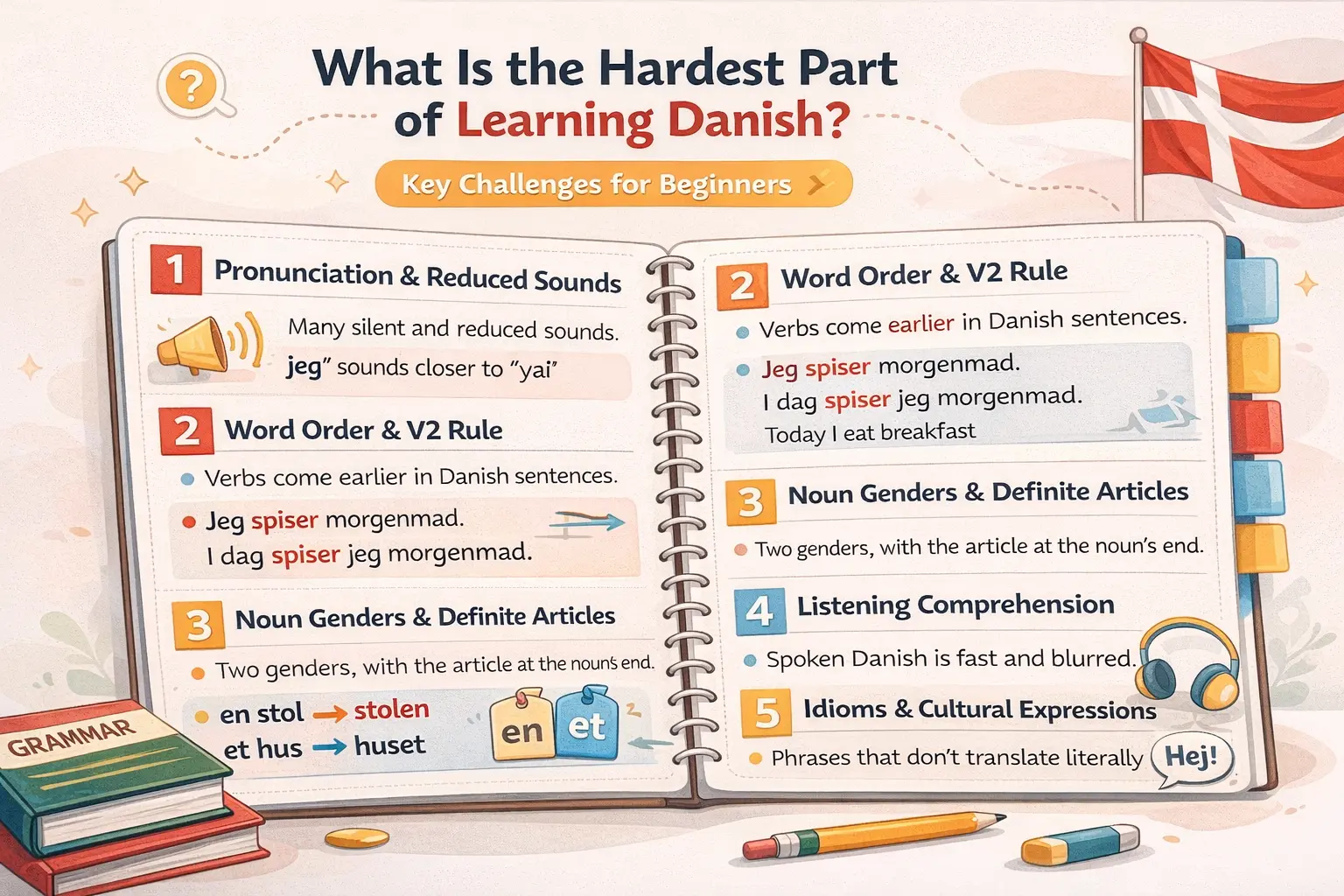
Learning Danish is an exciting journey, but it comes with unique challenges. If you’ve ever wondered, “What is the hardest part of learning Danish?” you aren’t alone. Most learners struggle with the same few hurdles.
1. Pronunciation and Reduced Sounds
By far, pronunciation is the most cited challenge. Danish features "stød" (a glottal squeeze) and many silent letters that make words look different than they sound.
| Word | Sounds Like | Meaning |
|---|---|---|
| Jeg | "Yai" | I |
| Brød | "Brø" (soft d) | Bread |
| Siger | "See-er" | Says |
The soft d is a good example. In mad (food) and gade (street) it sounds closer to the English “th” in “the” than to a hard “d”, and in hvad (what) you hardly hear it at all. Vowels are another challenge: læse (to read), løse (to solve) and lyse (to shine) differ only in the first vowel, so practise them as a set.
2. Word Order and the V2 Rule
The Verb-Second rule requires the verb to stay in the second position. It’s the #1 grammar mistake for English speakers.
3. Noun Genders (En vs. Et)
There is no logical reason why a "house" is et hus but a "chair" is en stol, so you have to memorize many of them. Two things help: about three in four nouns are en words, and some endings give clues (-ing, -hed, -else are usually en; -um is usually et). See more inIs Danish Grammar Hard?
4. Listening Comprehension
Native Danish is fast and "swallowed." To overcome this, you must expose your ears to natural speech daily. OurYouTube Channel is designed specifically to help you bridge this gap.
5. The "Glottal Stop" (Stød)
This is a unique sound that doesn't exist in English. It can change the meaning of a word entirely! The classic example is hun (she) and hund (dog): the d in hund is silent, and the only difference is the short “catch” in the voice in hund. While it's hard to master, natives will usually understand you from the context even if you don't get it perfect right away.
6. Numbers
Danish numbers surprise almost everyone. From 21 upwards, the ones come first: enogtyve is literally “one-and-twenty”. The tens from 50 to 90 use an old counting system, so the words don’t look like the digits:
| Number | Danish |
|---|---|
| 50 | halvtreds |
| 60 | tres |
| 70 | halvfjerds |
| 80 | firs |
| 90 | halvfems |
Don’t try to understand the history first. Learn the five words by heart and practise with prices and phone numbers, for example femogtres kroner (65 kroner). Ournumber practice helps you hear them.
7. Words That Look Like English
Some Danish words look familiar but mean something else. These “false friends” cause real misunderstandings:
- grim means “ugly”, not “grim”.
- gift means “married” (and also “poison”), not “gift”. A present is en gave.
- frokost means “lunch”. Breakfast is morgenmad.
- eventuelt means “possibly” or “if needed”, not “eventually”.
Everyday speech also uses plenty of informal words you won't find in a textbook. Ourguide to Danish slang explains the most common ones.
What should you practise first?
Do not try to solve every difficulty at once. Start with clear vowel sounds and the rhythm of short phrases, then add grammar patterns that you can reuse. A beginner who can say Jeg vil gerne have kaffe naturally has a more useful foundation than someone who has memorized a long list of isolated pronunciation rules. Record yourself once a week and compare the rhythm, not only individual sounds.
- Choose five everyday sentences and listen to a native version.
- Repeat each sentence slowly, then at natural speed.
- Underline the verb and practise changing one detail, such as the time or place.
- Use the new sentence in a conversation or voice note within 24 hours.
A realistic weekly target
Spend three sessions on listening and shadowing, two sessions on sentence structure, and one short session reviewing noun genders. Keep the final session for free speaking. This balance addresses the hardest parts of Danish while still giving you measurable progress.
How to Overcome the Challenges
- Shadowing: Repeat after native speakers to mimic their rhythm.
- Consistency: 15 minutes a day is better than 3 hours once a week.
- Context: Learn words in phrases, never in isolation.
- Use Tools: Practice your vocabulary in our Vocabulary Lab.
Danish is a challenge, but it's a rewarding one. Every mistake is a step closer to fluency. Start practicing today!