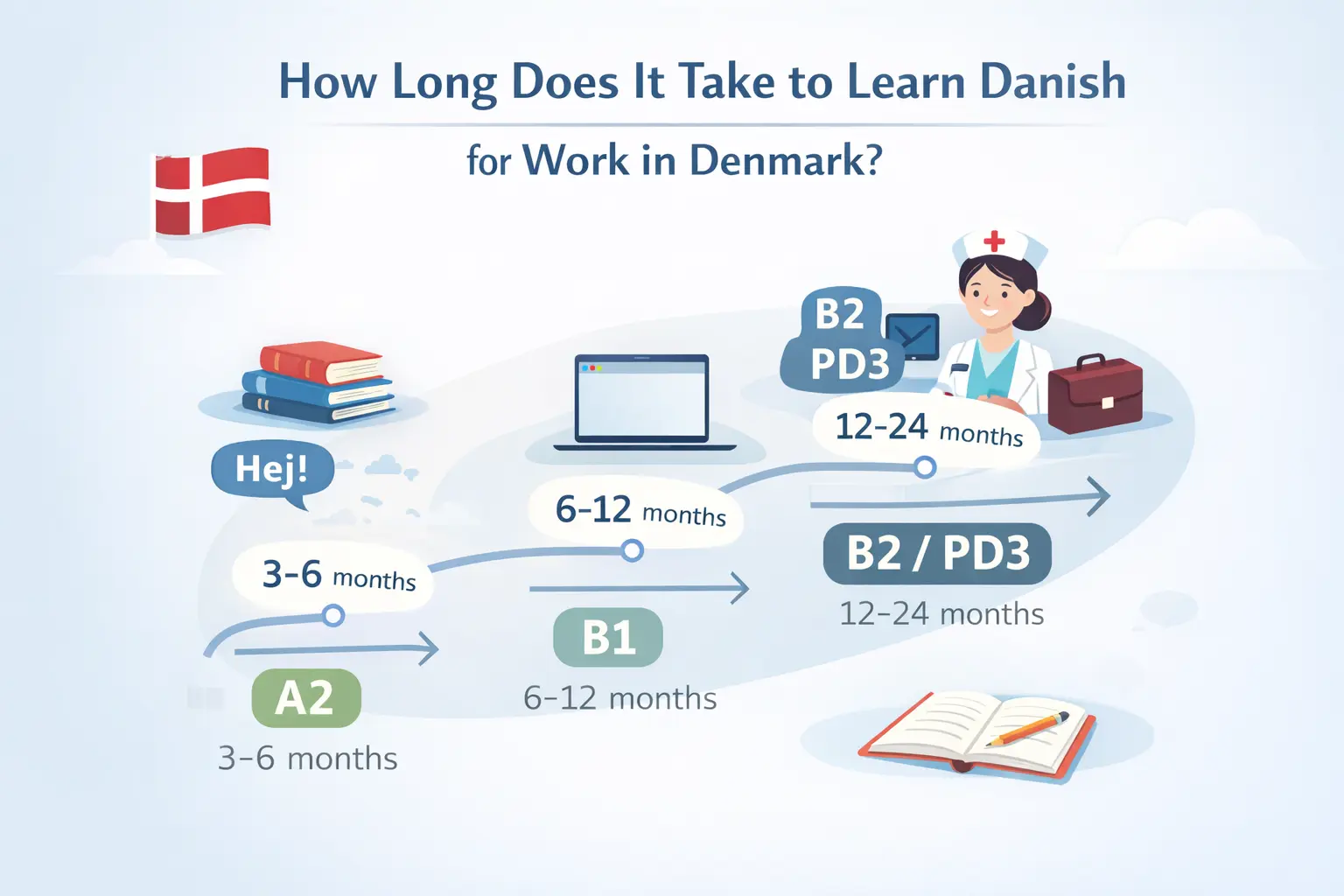
One of the most common questions people ask before moving to Denmark is: how long does it take to learn Danish for work?While the answer varies, reaching a functional level for the Danish job market typically takes between 6 to 18 months of consistent study.
Does Your Job Require Danish?
Not all industries have the same requirements. While the international tech scene often uses English, local sectors require official certification.
- High Requirement: Healthcare, Education, Law, and Public Administration.
- Moderate Requirement: Hospitality, SOSU (Elderly Care), and Customer Service.
- Low/Optional Requirement: IT, Engineering, Biotech, and Academic Research.
Danish Proficiency Levels Explained
Most employers refer to the CEFR levels or the official Danish Exam (Prøve i Dansk). Understanding these levels helps you set realistic goals.
| Level | What you can do | Timeline |
|---|---|---|
| A2 (Basic) | Simple workplace greetings and basic instructions. | 3–6 Months |
| B1 (Intermediate) | Hold meetings, handle customer calls, and write simple emails. | 6–12 Months |
| B2 / PD3 (Professional) | Professional fluency. Required for nurses and pedagogues. | 12–24 Months |
Requirements by Profession
If you are moving for a specific career, you should aim for these targets:
- Healthcare Workers (Nurses/Doctors): If you were educated outside the EU/EEA, you must pass Prøve i Dansk 3 (PD3) as part of Danish authorisation. Nurses and doctors need at least 10 in oral, 7 in reading and 7 in written communication. Doctors can read more in our Medical Danish guide for foreign doctors.
- SOSU Workers: There is no single national exam requirement, but SOSU schools and employers typically expect around Danskuddannelse 2 / B1 level so you can communicate with elderly citizens safely. Check with the school you apply to. Check our SOSU Language Guide for more.
- Office Professionals: Even if your office is English-speaking, reaching B1 level is the "magic key" to social integration and promotions.
The weekly hours matter more than the calendar
A six-month estimate means something very different at two hours per week than at ten. A sustainable plan for a full-time worker might be four focused study sessions of 30 minutes, two listening commutes, and one conversation practice each week. Track active practice rather than time spent browsing resources. Your plan should include vocabulary retrieval, sentence production, listening, and feedback.
Workplace milestones to test
- A2: introduce yourself, understand routine instructions, and ask for clarification.
- B1: explain a problem, write a short work message, and participate in predictable meetings.
- B2: discuss causes and consequences, document accurately, and follow fast workplace conversations.
These are learning milestones, not official authorization rules. Requirements can depend on profession, employer, municipality, and current regulation. For healthcare and regulated work, confirm the current requirement with the relevant Danish authority and employer before relying on a timeline.
Accelerate Your Timeline
The fastest way to reach "Work Level" is to master the 2,000 most common workplace words. Use our trainer to track your progress.
Start Vocabulary Practice →Is it Hard to Reach a Professional Level?
The biggest hurdle isn't the grammar—it's the pronunciation. Many learners can read and write Danish within months but struggle to understand colleagues in the canteen.
To avoid this, we recommend reading our guide on thehardest parts of learning Danishto prepare your ears for "swallowed" sounds.
Final Verdict
For most professionals, one year of consistent study (10-15 hours a week) is the realistic timeline to become a valuable member of a Danish-speaking workplace.
Official sources
Rules change. Always confirm with these official sources before making decisions. Last checked: 4 October 2026.
- Danskogproever.dk (SIRI): About Prøve i Dansk 3 – official content and grading of PD3, which corresponds to level B2.
- Lifeindenmark: Danish language training – the official guide to the free Danish courses (Danskuddannelse 1, 2 and 3).
- Danish Patient Safety Authority: Language test for nurses (non-EU) – the PD3 grades required for nurse authorisation.
- Danish Patient Safety Authority: Doctors educated outside the EU/EEA – the authorisation process for doctors, which starts with passing PD3.
- UddannelsesGuiden: Admission requirements for vocational programmes – official admission rules for programmes such as SOSU.