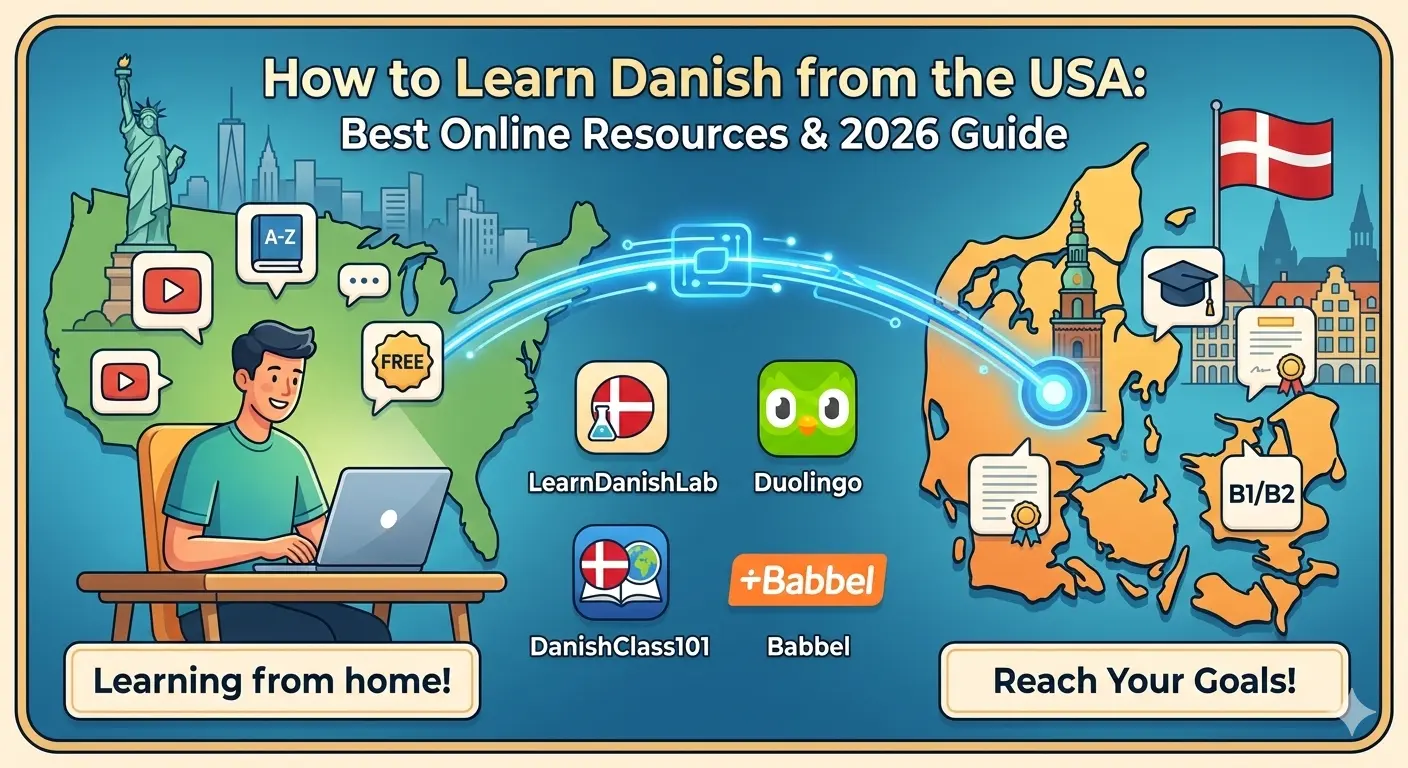
Are you living in New York, Austin, or Seattle and dreaming of moving to the cobbled streets of Copenhagen? Perhaps you just want to connect with your long-lost Danish heritage? In 2026, learning Danish from 4,000 miles away is not only possible; it is easier than ever. This guide is your map, providing the definitive, updated landscape of digital tools, immersive techniques, and specific hacks to master Danish from the USA without a local tutor.
A Note for the US Learner:
Don't be overwhelmed by the "300,000 compound words." For an English speaker, the core of Danish is surprisingly intuitive. The problem isn't complexity; it is differentiation. Our goal is to train your ear to hear sounds English ignores, and your brain to arrange words in an unfamiliar sequence. We are not just learning vocabulary; we are rewiring your communication logic.
Part 1: The 'V2' Trap and the Phonetic Wall — Why Americans Struggle (And How to Fix It)
If you have ever picked up a free language app and quit after three weeks, it probably wasn't your fault. It was the Danish Word Order (Ordstilling). This is the first significant mental roadblock for native English speakers.
For English speakers, grammar is simple: "I am eating an apple" (Subject-Verb-Object). In Danish, this sequence is malleable, dictated by the mighty V2 Rule (Verbalet på andenpladsen). In a main clause, the verb isalways the second element.
- English: Today I am eating an apple. (S-V-O)
- Danish: I dag spiser jeg et æble. (I dag = element 1, Spiser = element 2, jeg = element 3).
This shift causes your brain to constantly try and translate words back into English order before processing them. When you are 4,000 miles from the nearest native speaker, you need high-quality digital tools that reinforce the V2 logic, rather than just teaching you list of nouns.
V2 Success Tip:
When you practice, always pay attention to the location of the Verb. Treat it like the anchor. The subject and object might move, but the verb (in a main clause) remains steady at element two. Master this, and your reading comprehension will skyrocket. If you need dedicated practice, try our specializedV2 Rule Sentence Builder Module.
The Phonetic Wall: The Soft 'D' and the Legendary Stød
The second massive challenge is pronunciation. Textbooks often explain the "soft D" (blødt d) by saying it sounds like the 'th' in "mother." This is misleading. It is far softer, almost silent, more of a modification to the preceding vowel. For a remote learner, this "phonetic wall" makes listening to native content incredibly difficult, even if you know all the words on the page.
Then there is the Stød, the glottal catch in the throat. This is a melodic feature, not a separate sound, that can change the meaning of a word entirely. Think of the stød in "Møller" (Miller) vs. "møller" (millers). This is why a remote learner cannot rely on text alone; you must prioritize high-quality, authentic audio input to calibrate your ears.
Ear-Training Hack: Download the free application Audacity and a few minutes of native Danish speech. Slow the speed down to 50% without changing the pitch. Listen to how native speakers elide (swallow) consonants and modifications in vowels. This "micro-listening" technique is the "secret weapon" for mastering Danish phonetics while remote.
Part 2: The Digital Arsenal — The Definitive 2026 List of USA-Compatible Tools
You are not going to learn a complex V2 grammar system by swiping right for five minutes a day. To reach fluency, you need an organized, logical framework.
1. LearnDanishLab (The V2 & PD3 Specialist)
As a teacher, I created our Practice Hub specifically to bridge the "textbook gap." Many websites treat English speakers as "general learners." We treat you as "English-native learners." Our Interactive Word Order Modules andPD3 Exam Prep Guides focus precisely on the hurdles that other generic apps gloss over. If you want to understand why the language works the way it does (which is essential for exam success), this is your headquarters.
2. Duolingo & Babbel (The "Gateway" Habits)
Are these platforms going to make you fluent? No. But are they essential for your toolbox? Yes. Their job is "habit formation." They turn Danish from a "someday" project into a "today" task.
- Duolingo (The Motivational Engine): Its gamified approach with streaks and leaderboards is brilliant for maintaining consistency. However, be careful—it often misses the nuance of sentence construction and can reinforce incorrect patterns. Always supplement its lessons with a more robust grammar resource (like our grammar guide).
- Babbel (The Conversational Bridge): Babbel offers more structured dialogue simulations, which is great for remote learners. But when it asks you to complete a sentence, always double-check it against the V2 Rule logic. The V2 Rule is the ultimate truth-check for your app practice.
3. DR.dk & YouTube (Immersion, with a catch)
To truly internalize the language, you must immerse yourself in the content Danes actually watch.DR TV (Danish Broadcasting Corporation) is a goldmine of documentaries, news, and award-winning drama. This is the most valuable immersion tool you have—but you must use it correctly.
The 4,000-Mile Catch: A VPN is Required.Most content on DR.dk is geo-blocked outside of the European Union. Living in the US, you will need a reliable VPN service (like NordVPN or Surfshark) to mask your location and connect to a server in Denmark. This single technical fix unlocks thousands of hours of authentic Danish input.
How to Watch effectively: Do not just turn on a show and hope for the best. For Americans, the secret weapon is watching with Danish subtitles, not English subtitles. If you use English, your brain ignores the Danish audio. Danish subtitles connect the phonetic (listening) wall we discussed to the vocabulary you already know.
Part 3: The 2026 Immersion Framework — Replicating Copenhagen in Kansas
You have your tools; now you need a system. We cannot rely on "casual absorption" because you aren't hearing Danish on the subway. We must create an "Input Engine."
The Goal is 1 hour of active Danish immersion per day. "Active" means you are not just passively listening; you are processing the language.
- Active Vocabulary (30 mins): Use a spaced repetition system like Anki or Brainscape. Don't just make single-word cards. Create sentence cards where you must recall the correct conjugation of a verb in context. (e.g., "I went to the store" → Jeg [went] til butikken). Check our guide on memory tricks for complex nouns.
- The "Input Engine" (30 mins): This is your DR.dk time.
- Level 1 (Beginner): Watch children's programming (Børne-TV) with Danish subtitles. The language is simple, clear, and focused on everyday concepts. Try "Ultra Nyt" for news tailored to a younger audience.
- Level 2 (Intermediate): Watch documentaries on topics you already know about (e.g., WWII history, nature). If you understand the concept of the documentary, you can infer the language.
- Level 3 (Advanced): Watch original Danish drama series (e.g., Borgen, Matador) without subtitles.
Podcast Success: Podcasts are essential for remote learners. If you are struggling to understand why Danish vowels sound the way they do, download "Dansk i ørerne." It is a podcast specifically for learners where the host speaks slowly and clearly, connecting vowel modifications to the written word. It’s perfect for the "Ear-Training" hack we discussed.
Your 3-Step 2026 Action Plan
- Morning Habit (15 mins): 10 minutes of active vocabulary on a flashcard app, followed by 5 minutes of Duolingo "streak-maintenance." Primary Focus: Vocabulary Acquisition.
- Lunch Integration (15 mins): Listen to one Danish podcast episode (e.g., "Dansk i ørerne") during your commute or lunch break. Revisit the "Ear-Training" hack once a week. Primary Focus: Phonetic Calibration.
- Evening Core (30 mins): 15 minutes of an interactive sentence practice lesson (like our V2 modules), followed by 15 minutes of immersive input on DR.dk (using a VPN). Primary Focus: Structural Mastery.
Final Call
The 4,000-mile journey is now possible.
All you need is the right map.
We are the V2 specialists. 🇺🇸➡️🇩🇰
Advanced Topics for the US Danish Learner (SEO Spotlight)
If GSC data is showing interest in specialized topics like `SOSU` or `Prøve i Dansk 3` (PD3), we must address them. These are high-value queries for GSC authority.
Preparing for the PD3 from the USA
The PD3 (Prøve i Dansk 3) is the required exam for citizenship and many jobs. You can prepare remotely! Our specialized PD3 Hub provides mock oral exam scenarios, checklists, and scoring breakdowns. US students preparing remotely should focus on the Written Presentation, which is easier to perfect through digital feedback.
Specialized Danish: SOSU and Healthcare (GSC Hot Topic)
Are you a healthcare worker moving to Denmark? General Danish won’t cut it. You need Healthcare Danish (SOSU/Medicin). This specialized vocab has very low competition in search results. Check out our new Interactive SOSU Scenarios to practice patient interaction vocabulary.
FAQ: Common Questions from Remote Danish Learners
How do I practice speaking Danish when I'm in the USA?▼
Use language exchange apps like HelloTalk or Tandem to find native speakers. You can also record yourself repeating sentences and use the slowed-down Audacity trick to compare your pronunciation.
Is there a difference between written and spoken Danish?▼
Yes. Textbooks teach a very structured written form. In spoken Danish, consonants are often elided (swallowed), and vowels are modified, which is why authentic immersion via DR.dk is crucial.
Is Duolingo Danish good?▼
It’s a great 'motivational habit-former' but should never be your primary grammar resource. Always supplement it with detailed grammar guides that explain the V2 rule.
Can I learn Danish for free online?▼
Yes! Many high-quality resources (like our V2 practice modules and YouTube) are free. Immersion with DR.dk is also free if you have a VPN.
How do I learn specialized SOSU vocabulary?▼
Niche topics like 'Danish for Healthcare Workers' are high-value. Since textbooks rarely cover this, you need resources like our interactive SOSU scenarios or specialized vocabulary lists.
Your 4,000-Mile Masters Degree in Danish Start Today.
Mastering Danish from the US isn't a pipe dream; it's a technical, systematic achievement. By identifying the specific linguistic challenges (like V2) and cultural gaps (the Phonetic Wall) you face as a remote learner, you can use the right tools to build a comprehensive immersion framework. We aren't generalized learners; we are targeted, efficient, global learners. Replicate Copenhagen in Kansas, and the language will be yours.
We are the targeted grammar specialists, built to solve the "Danish from Home" problem. We have mapped the logic; now, you must write your journey.