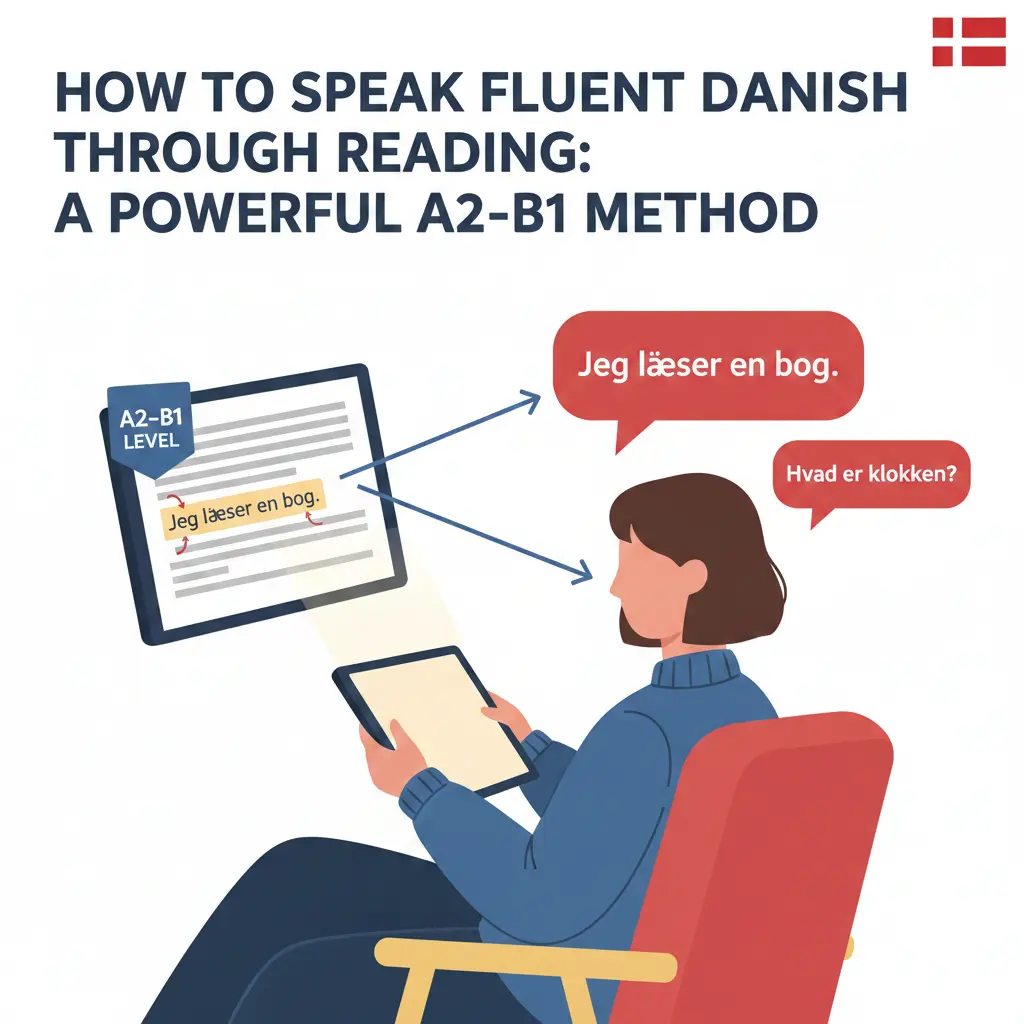
Many Danish learners at A2–B1 level feel stuck. You may understand grammar rules and know vocabulary, yet speaking still feels slow and unnatural. One powerful but often overlooked method to improve spoken Danish is reading. When used correctly, reading can directly improve how fluently you speak.
Why Reading Helps You Speak Better Danish
Speaking is not just about pronunciation. It’s about forming correct sentences automatically. Reading exposes you to natural Danish sentence patterns again and again, helping your brain internalize word order, verb placement, and expressions.
At A2–B1 level, this is critical. You already know the basics. What you need now is repetition in context.
How Reading Improves Sentence Structure
Danish follows specific sentence rules, such as the verb-second (V2) structure. When you read regularly, you start recognizing these patterns without thinking.
Example:
- I dag arbejder jeg hjemme.
- Normalt spiser vi klokken seks.
Seeing these structures repeatedly makes them easier to reproduce when speaking.
What Kind of Reading Works Best (A2–B1)
Not all reading helps equally. At this level, focus on:
- Short blog posts written for learners
- Simple news articles
- PD3-style reading texts
- Grammar explanations with examples
Avoid very complex novels or advanced academic texts. The goal is clarity and repetition, not difficulty.
The Reading-to-Speaking Method (Step by Step)
- Read a short Danish text once for general understanding.
- Read it again and notice sentence structure and verb placement.
- Choose 3–5 sentences and read them aloud.
- Close the text and try to say the sentences in your own words.
- Reuse the same structures in daily conversation.
How This Helps Pronunciation (Indirectly)
Even though reading is visual, it still supports pronunciation. When you combine reading with listening or reading aloud, you strengthen the connection between written and spoken Danish. This makes spoken Danish sound more natural over time.
Use Structured Reading Resources
Websites with clear explanations and learner-friendly texts are ideal. LearnDanishLab focuses on:
- Clear Danish grammar explanations
- Sentence structure guides
- Blogs designed for real language use
- PD3-relevant content for A2–B1 learners
You can explore structured reading content here: LearnDanishLab
Common Mistakes to Avoid
- Only reading silently without speaking aloud
- Reading texts far above your level
- Focusing on every unknown word
- Not reusing sentences in speech
A 20-minute reading-to-speaking routine
Choose a text of 150 to 250 words that is slightly easier than your maximum reading level. Spend five minutes reading for meaning, five minutes marking useful phrases, five minutes reading three sentences aloud, and five minutes speaking without looking at the page. In the final step, change the subject, time, or place in each sentence. For example, turn I dag arbejder jeg hjemme into I morgen arbejder jeg på kontoret.
Keep a phrase notebook rather than a list of single words. Write the original sentence, your adapted sentence, and one pronunciation note. Revisit the same phrases after two days and again after a week. If you can use the pattern in a new context, the reading has become speaking ability rather than passive recognition.
Measure the right progress
- How many sentences can you retell without looking?
- Can you change the tense or word order correctly?
- Can you summarize the text in three Danish sentences?
- Do you notice fewer pauses when reusing familiar structures?
Fluency comes from understanding patterns, not memorizing words.
Review Danish sentence structure
If you are at A2–B1 level, reading the right way can unlock fluent Danish speaking. Focus on structure, repetition, and real examples, and your speaking will improve naturally.