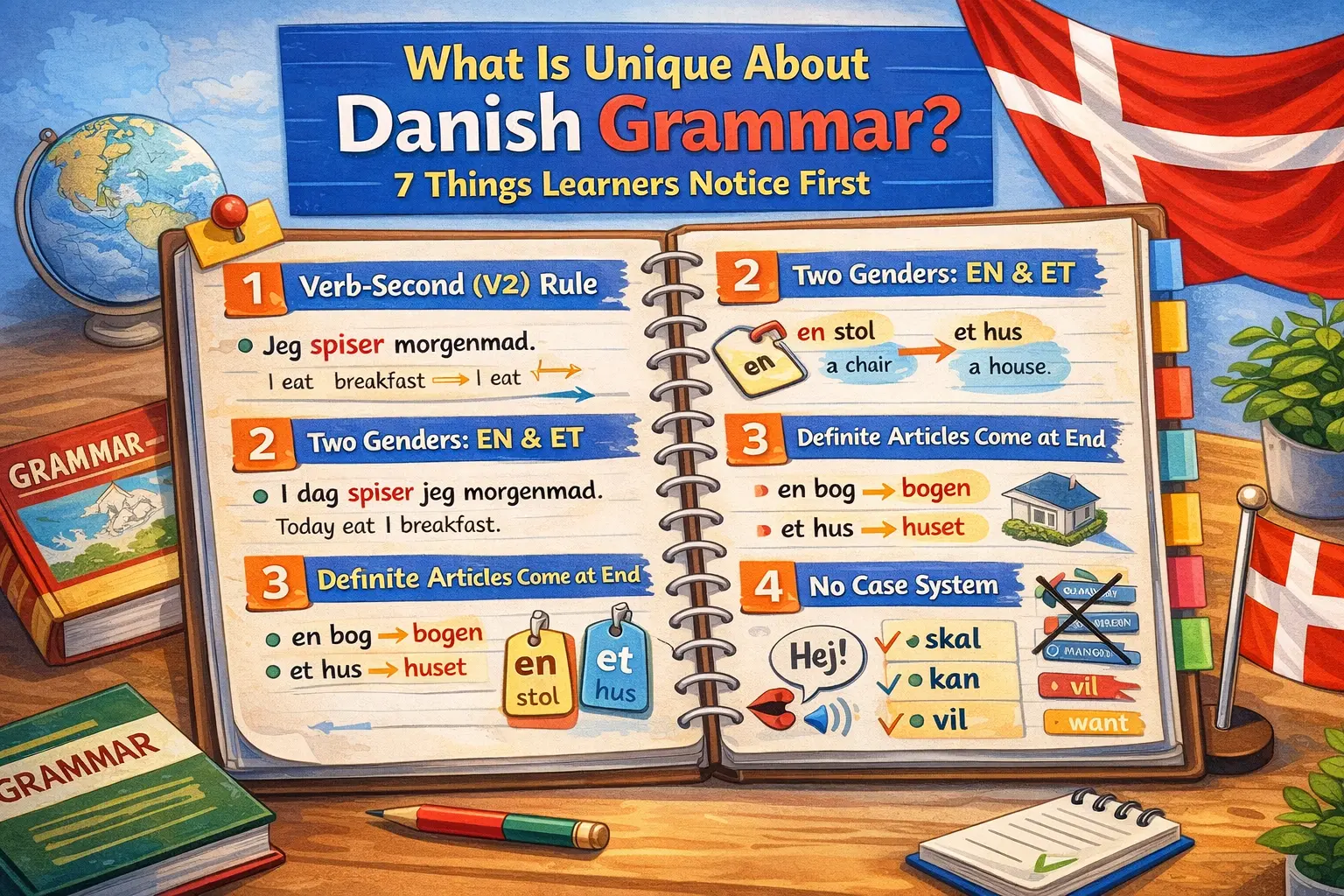
Danish grammar is often described as simple but strange at the same time. For many learners, it is not the grammar itself that feels difficult, but how different it is from what they expect.
1. The Verb-Second (V2) Rule
In main sentences, the verb must always appear in the second position. If you want to dive deeper into this, read our guide onDanish Sentence Structure.
“Second position” means the first element can change, but the finite verb stays in slot two. Compare Jeg arbejder i København (I work in Copenhagen) with I København arbejder jeg (In Copenhagen, I work). The location moves to the front, while arbejder remains the second element. This is one of the most useful patterns to practise because it appears in ordinary conversation, not only in formal writing.
2. Only Two Genders: EN and ET
Danish nouns belong to one of two genders: en or et. Most learners memorize the noun together with its article.
3. The Definite Article Comes at the End
Unlike English, Danish adds the definite article to the end of the noun (suffix). En bog (a book) → Bogen (the book).
The same idea appears with plural nouns: en bil becomes bilen (the car), while biler means cars and bilerne means the cars. Do not treat the ending as decoration; it carries information that English places before the noun. When learning vocabulary, write the indefinite form and definite form together so your memory stores the complete pattern.
4. No Case System
Danish does not use grammatical cases like German. This makes it much more accessible for English speakers.
5. Spelling vs. Pronunciation
Many letters are silent, like the "d" in brød or the "g" in jeg.
Spelling still gives you useful clues, but it is not a reliable pronunciation guide by itself. Learn a new word with an audio example, then say it in a short phrase rather than repeating it in isolation. For instance, practise jeg er træt (I am tired) as one rhythm unit. This builds listening and speaking habits at the same time and prevents you from adding an English-style sound to every written consonant.
6. Frequent Use of Modal Verbs
Danish uses modal verbs like skal, kan, and vil to express daily intentions. You can see a full list of these in ourDanish Verb Directory.
7. Consistency is Key
The rules rarely change, which rewards students who practice regularly.
A five-minute grammar routine
Choose one noun, one verb, and one time or place phrase. First write a neutral sentence, such as Jeg læser dansk om aftenen. Then move the time phrase to the front: Om aftenen læser jeg dansk. Finally, change the noun phrase from indefinite to definite where it makes sense. Say both versions aloud and underline the finite verb. This small routine trains word order, pronunciation, and article endings together instead of separating grammar into disconnected rules.
Check your understanding
- Move I dag to the beginning of Jeg arbejder hjemme.
- Change en bog into “the book”.
- Write one sentence with kan and one with skal.
Answers: I dag arbejder jeg hjemme, bogen, and any meaningful sentences such as Jeg kan komme or Jeg skal øve mig.
Want all the rules in one place? See our complete Danish grammar guide, with every rule explained and free exercises for each topic.
Danish grammar may feel unique, but its logic becomes clear once you start building your first sentences!